
Vance County Parole Versus Probation
North Carolina uses several forms of community supervision. Probation is generally a community sentence imposed by a court. It may be ordered instead of an active jail or prison term, or it may follow a suspended sentence. Parole is discretionary release for people who remain eligible under older sentencing law. North Carolina Structured Sentencing ended discretionary parole for offenses committed on or after October 1, 1994. Post-release supervision, often called PRS, is the required supervised part that follows many current prison sentences. The North Carolina Division of Community Supervision administers these forms of supervision.
Custody and supervision answer different questions. An NCDAC record can show an inactive prison status and an active probation, parole, or PRS status at the same time. That means the person has left prison but has not completed the supervised part of the case. A Vance County jail release may also occur without any NCDAC supervision. For example, a person released on bond remains tied to a court case but is not thereby placed on parole. The source of the status must be identified before its meaning is described.
| Supervision type | How it begins | Best verification source |
|---|---|---|
| Probation | A court orders community supervision, often with a suspended sentence | NCDAC OPI status plus Community Supervision |
| Parole | The Commission approves eligible release under older sentencing law | Commission result, then NCDAC OPI release and status fields |
| Post-release supervision | A person leaves prison for the supervised portion of a structured sentence | NCDAC Actual Release Date and PRS status |
- Discharge
- The formal end of a custody or supervision obligation in the responsible system.
- Absconder
- A supervised person whom NCDAC identifies as actively avoiding supervision.
- Revocation
- An official action that can end community placement and return a person to custody.
- Detainer
- A request or hold from another authority that can affect where a person goes.
Check Vance County Post-Release Supervision
The public starting point is the NCDAC Offender Public Information Search. It covers state prisoners, probationers, parolees, post-release supervisees, and historical NCDAC information. It does not cover a county-jail-only stay. Search by offender number when known because it is more precise than a name. Otherwise, use the name fields and narrow by date of birth or age. Soundex can help with spelling variants. Compare the returned identity and sentence details before relying on a status.
Read both top-level status fields. “Inmate Status” addresses state prison custody. “Probation/Parole/Post Release Status” addresses community supervision. The sentence history may also show supervision dates, commitment type, conviction county, docket, offense, and release fields. Multiple sentence rows can exist for one person, so match the Vance County case and the relevant custody episode. An old inactive row does not rule out a newer active record.
- Open NCDAC OPI and choose “Active Probationer/Parolee” for a current supervision check.
- Enter the offender number, or use the full name with date-of-birth or age filters.
- Open the correct person and compare conviction county, docket, sentence dates, and other lawful identity fields.
- Read prison status separately from probation, parole, or post-release status.
- Use the official Community Supervision directory for current office routing or reporting instructions.
- When the record is unclear, ask NCDAC to confirm the exact status and the date through which it applies.
For a Vance County jail event with no state prison or supervision history, begin with the Sheriff instead. The detention center can confirm whether the person left local custody, while the broader Vance County released-inmate search path explains how to separate community release from transfer. NCDAC should not be used to fill a gap it does not cover.
Note: A public status is a starting point; personalized reporting terms must come from the responsible supervision office.
Vance County Supervision Office Routing
NCDAC did not provide a reliably verified Vance field-office row in the material used for this project. A street address or local officer should not be guessed. Use the official Community Supervision office directory for the current local route. The statewide Division of Community Supervision can answer agency-level questions and point a caller to the responsible unit. Public OPI may establish active or inactive status, but it may not display a named officer or the instructions that apply to the individual.
North Carolina Community Supervision
2020 Yonkers Road, MSC 4250
Raleigh, NC 27699-4250
Phone: 919-716-3100
When calling, identify whether the question concerns probation, parole, or PRS and have the offender number or case reference ready if appropriate. Do not assume the office is based on a last known home address. Assignment can change, and a stale directory may route the call to the wrong district. The supervising agency is the sound source for conditions, appointments, transfer of supervision, and the formal end date.
Vance County Parole Review Records
The North Carolina Post-Release Supervision and Parole Commission handles parole decisions for eligible older-law cases and sets post-release conditions within its authority. The official parole process explains that eligible cases are generally reviewed at least annually after eligibility, with stated exceptions for some offense categories. Decisions require a majority vote. Eligibility is not a release date, and a review does not mean release has occurred.
North Carolina does not operate a conventional public calendar of group parole hearings. Commissioners usually review files and vote independently rather than convening a face-to-face group hearing. The state describes a video-review exception for certain people convicted as juveniles and serving life with parole. This process is why a weekly Vance County “parole hearing docket” should not be expected or invented.
The closest bounded results source is the Discretionary Parole Reviews page. Monthly spreadsheets have been published since September 2024. Verified columns include OPUS number, name, parole type, decision, denial codes, primary offense, time served, and sentence imposed. Observed decisions include approve, deny, and incomplete. Even an approval should be checked against OPI’s Actual Release Date and current supervision status because a decision is not the physical prison exit.
The official parole-process page is shown in the source capture below.
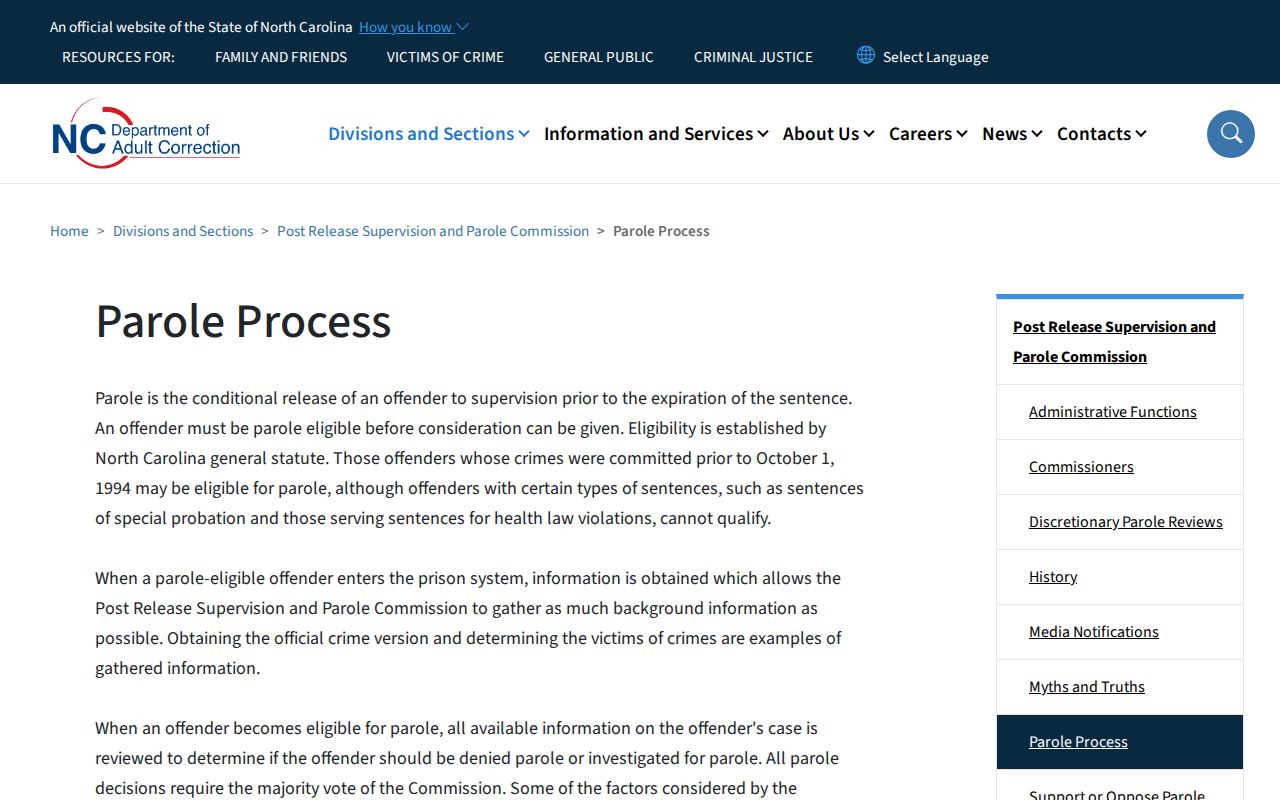
The capture helps distinguish North Carolina parole review from a public county hearing calendar.
Vance County Absconder Status Checks
NCDAC offers a separate Absconded Probationer Search. It accepts a last name with an optional Soundex search or a county of supervision, including Vance. An absconder flag is an enforcement status, not a release event. It does not erase the prior prison release, prove that the person is now in the Vance County Detention Center, or show that the person has been arrested. Check the live detail and then contact the responsible agency.
The Vance selector and search layout appear in the official absconder-search source below.
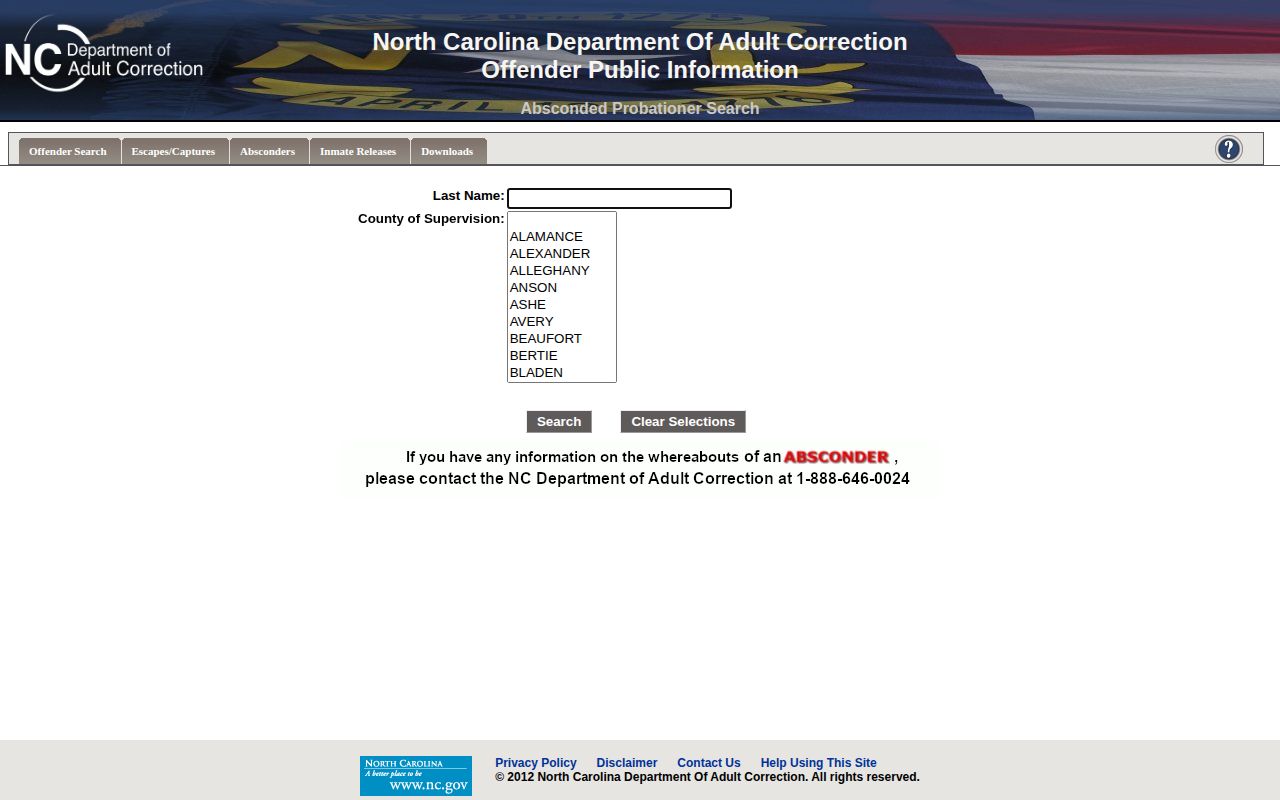
This search should be used to read the current supervision flag, not as a list of people released from the county jail.
North Carolina’s NC SAVAN service can also provide notifications tied to probation, parole, PRS, county jail, and prison records. A SAVAN event should still be read in the context of the reporting agency. A supervision event is not always a custody event, and neither one proves that all holds or cases have ended. Where the absconder search, OPI, and a custody notice appear to conflict, first ask whether they describe different dates or systems.
Note: Absence from the absconder search is not proof that a supervision term is active, inactive, or fully discharged.
Vance County Supervision Enforcement History
A Vance-specific NCDAC operation shows why a current official check matters. In September 2025, NCDAC reported a joint enforcement operation that captured five absconders, made five probation-violation arrests, and conducted sixteen warrantless searches with local, state, and federal partners. Those figures describe that operation, not a standing count of all people under supervision in Vance County.
The event is also a warning about terms. An absconder listing can lead to enforcement action, but the listing itself is not a jail booking, a warrant return, or a new release record. If an arrest followed, custody must be verified with the agency that made or received the arrest. If no arrest is shown, do not infer one from the older press release. Current OPI data and direct agency contact carry more weight than a dated enforcement summary.
Vance County Reentry Navigation
NCDAC lists the Kerr-Tar Local Reentry Council for Vance, Granville, Warren, Franklin, and Person counties. It is a regional navigation contact for people leaving custody and their families. Its listing gives 252-436-2040 extension 2043 and hbradby@kerrtarcog.org. The separate Vance County reentry resources page provides local resource material.
The council is not the parole board, a supervision office, a jail, or a source of official custody status. It should not be asked to certify a release or change a supervision record. Its role here is purpose-neutral navigation. Availability and the precise help offered should be confirmed directly. For release proof, stay with the Vance Sheriff, NCDAC OPI, the Commission, or Community Supervision as the custody type requires.
Vance County Supervision Discharge
Supervision ends through an official discharge, expiration, or other agency and court process, not simply because a date has passed on an old web result. For PRS, North Carolina law describes the supervised tail of the structured sentence and when completion terminates the sentence under its terms. Probation end dates can be affected by the court record and later action. Parole can involve Commission authority. Revocation or return may create a new custody episode before discharge.
Use the current status, history, and dates in OPI, then seek agency confirmation when formal proof is needed. Ask which supervision type ended, the effective date, and whether the record is final. Court files can explain probation judgments and later orders, while NCDAC controls its supervision record. A public record that later disappears may reflect retention, correction, sealing, or expunction. The sound conclusion is limited to what the responsible source confirms.
Note: If sources disagree, compare the custody episode, supervision type, source date, and responsible agency before drawing a conclusion.